
- Home
- Grading, drainage and erosion control
Grading, drainage and erosion control
Wet corners, washing driveways and hillsides that are quietly moving. Dirt problems that no amount of mowing will fix.
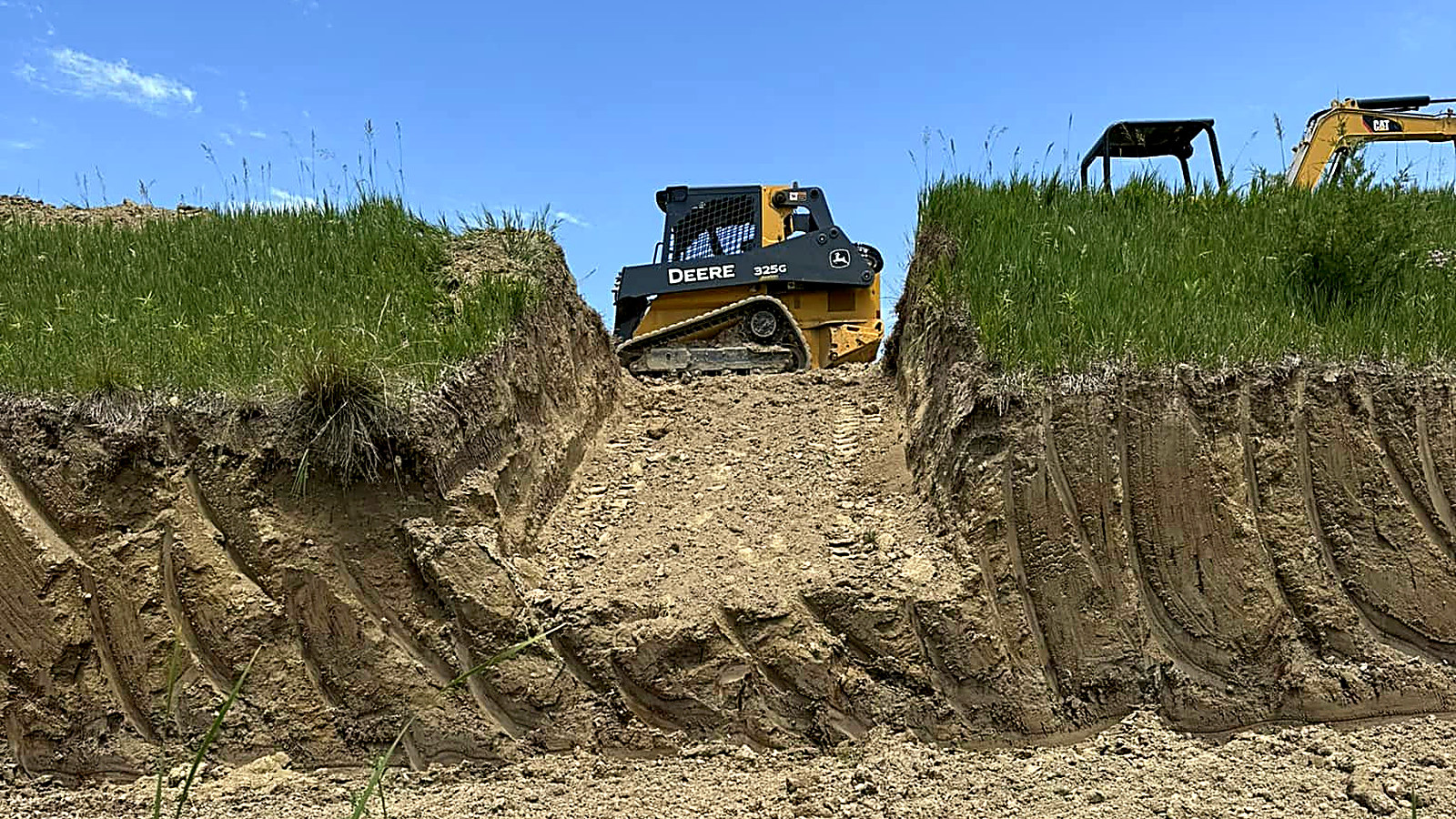
Loess will stand up straight until it doesn't.
The Loess Hills are wind-deposited silt, piled up along the Missouri River at the end of the last glaciation and found at this depth in only a handful of places on earth. The soil holds a near-vertical face when it is dry, which is why the road cuts around here look like walls.
Add water with somewhere to go and it behaves completely differently. A rut becomes a channel, a channel becomes a gully, and a gully takes the corner of a driveway with it. Most of the erosion problems we get called about started as something that looked minor two springs ago.
The fix is almost always about where the water goes, not about the spot where the damage shows. Chasing the symptom is how people end up hauling in fill every year.
- Yard grading and levellingRe-establishing fall away from the house and taking out the low spots.
- Drainage solutionsSwales, French drains, downspout runs, culvert and tile work.
- Erosion controlSlope stabilisation, seeding and matting, rock armouring where water concentrates.
- Timber restorationClearing overgrowth and re-establishing ground cover on wooded ground.
- Acreage and rural workDriveways, ditches, approaches and the ground the mower cannot help.
Three problems, over and over
- The driveway that keeps washingGravel ends up at the bottom every spring. Usually the crown is gone and there is nowhere for the water to leave, so it runs the length of the drive instead of across it. Regrade the crown, give it an outlet, and the gravel stays where you put it.
- The corner that never dries outA low spot with no fall to anywhere. It kills the grass, it breeds mosquitoes, and it is why the mower leaves ruts. Either the ground gets reshaped to drain or the water gets a pipe to leave through.
- The slope losing ground every yearBare loess with water running over it will keep going until something stops it. That means slowing the water down, spreading it out, and getting roots into the face before the next big rain.
If any of that sounds like your property, the useful thing is a photo taken during or just after a heavy rain. Where the water actually goes is the whole diagnosis.
Why we do the dirt and the grass
Most lawn companies stop at the turf and most excavators do not come back to seed it. That gap is where properties get stuck: the drainage never gets fixed because it is nobody's job, or it gets fixed and then left as bare dirt to wash out again.
The work ends in grass
Bare loess is the problem, not the solution. Every grading and erosion job we do finishes with the ground seeded, matted where it needs it, and watched through establishment. We are already on the property every week, so we see whether it took.
Questions we get
How do I know if I have a drainage problem or just a wet spring?
If the same spot is wet after every rain, holds water more than a day, or the grass in it dies out each year, that is a grading problem. A wet spring is everywhere at once and gone in a week.
Can you fix water getting into my basement?
We can address what is happening outside, which is often the whole cause: ground sloping toward the house, downspouts dumping at the foundation, or a window well with no drainage. If the problem turns out to be the foundation itself, that is a waterproofing contractor's job and we will say so.
What is loess and why does it matter for my yard?
Loess is wind-blown silt, and the Loess Hills along the Missouri River are one of the few places it sits this deep. It holds a steep face when dry and cuts fast when water concentrates on it. That is why erosion here goes from unnoticeable to serious in a couple of seasons.
Do you seed after the dirt work?
Always. Leaving bare loess exposed undoes the job. Grading and erosion work finishes with seed, and matting on anything steep enough to need it.
How long does a drainage job take?
Most residential regrading and drainage runs are one to three days on site. Acreage work with long runs, culverts or slope stabilisation takes longer. We will give you a realistic window when we quote rather than an optimistic one.
Is the yard going to be torn up?
For a day or two, yes. There is no way to move dirt without moving dirt. We keep the working area as tight as the job allows and we restore what we disturb.
Show us the wet spot.
A couple of photos after a hard rain tells us more than a description. Send them over and we will come look.
(712) 520-3402 Sharp Blades Lawn Care500 Railroad Ave, Glenwood, IA 51534